


What is the theme for Black History Month UK 2026?
Updated: Oct 7
Angela M explains Black History Month UK and how to celebrate this October.
October marks the start of Black History Month UK – a time to celebrate and remember African and Caribbean heritage peoples' achievements and contributions to the British economy, culture, and history. It's a chance to tell the stories of those lesser well-known Black Britons who we will forget if we don't showcase them.
What is Black History Month UK?
Black History Month UK began in October 1987 by Akyaaba Sebo, a special projects coordinator of the Ethnic Minorities Unit at the now defunct Great London Council. He wanted to boost the self-esteem of Black British children and young adults by educating them on the long history and achievements of Black people living in the UK.
Taking inspiration from Black History Month (also known as African American History Month) in the United States. The first event was held on 1 October 1987 at County Hall and was attended by American historian Dr. Maulana Karenga, who founded the African American holiday of Kwanzaa; and Kenyan women’s activist Wanjiru Kihoro.
It has since evolved into a national movement recognised by the British government and observed throughout the UK. It is also recognised in other parts of the world during October in Ireland and the Netherlands. In the US, where Black History Month originated, the awareness month is held in February. It is also celebrated in Canada in February too when it was officially recognised in 1995.
Since the 1990s, the significance of Black History Month has gradually increased throughout continental Europe and it is now observed in Germany and Belgium in February.
What are the origins of Black History Month?
In 1926, African-American historian Carter G Woodson started national Negro History Week to advocate for the inclusion of American Black History in the US national public education system. Over time, and with the momentum and support of the Civil Rights Movement in the 1960s, the week gradually morphed into the month it is today. In 1976, US Black History Month (or African American Month as it’s now regularly referred to) was officially recognised by President Gerald Ford.
Why is it celebrated at different times across the globe?
After visiting America in the 1970s, Addai-Sebo created a British version of Black History Month in 1987, but they are not officially linked.
In the United States, Black History Month takes place in February to coincide with the births of Frederick Douglass and Abraham Lincoln.
Addai-Sebo chose to celebrate Black History Month UK in October because of the month's importance in the African calendar. More importantly, it was the start of the British academic year.
Why should we separate Black History Month celebrations in the US and UK?
When Black History Month UK started in the UK, there was a big emphasis on African American history. Over time the focus has moved to celebrating and recognising Black British history and key Black figures in the UK.
It’s important also that we focus only on British Black history as the Black British community is a composite of peoples with different cultures and identities. Some individuals with a lineage beginning long before the Windrush generation and others with distinct and very different cultures rooted in the African and Caribbean continents.
Why do we celebrate Black History Month UK 2026?
Who gets to tell the story of Britain? And who decides which stories are heard, remembered and passed on?
Black History Month UK is an opportunity to ask these questions and recognise the Black people and communities who have helped shape Britain’s history, culture and society. Often in the face of discriminatory barriers designed to keep their voices at the margins.
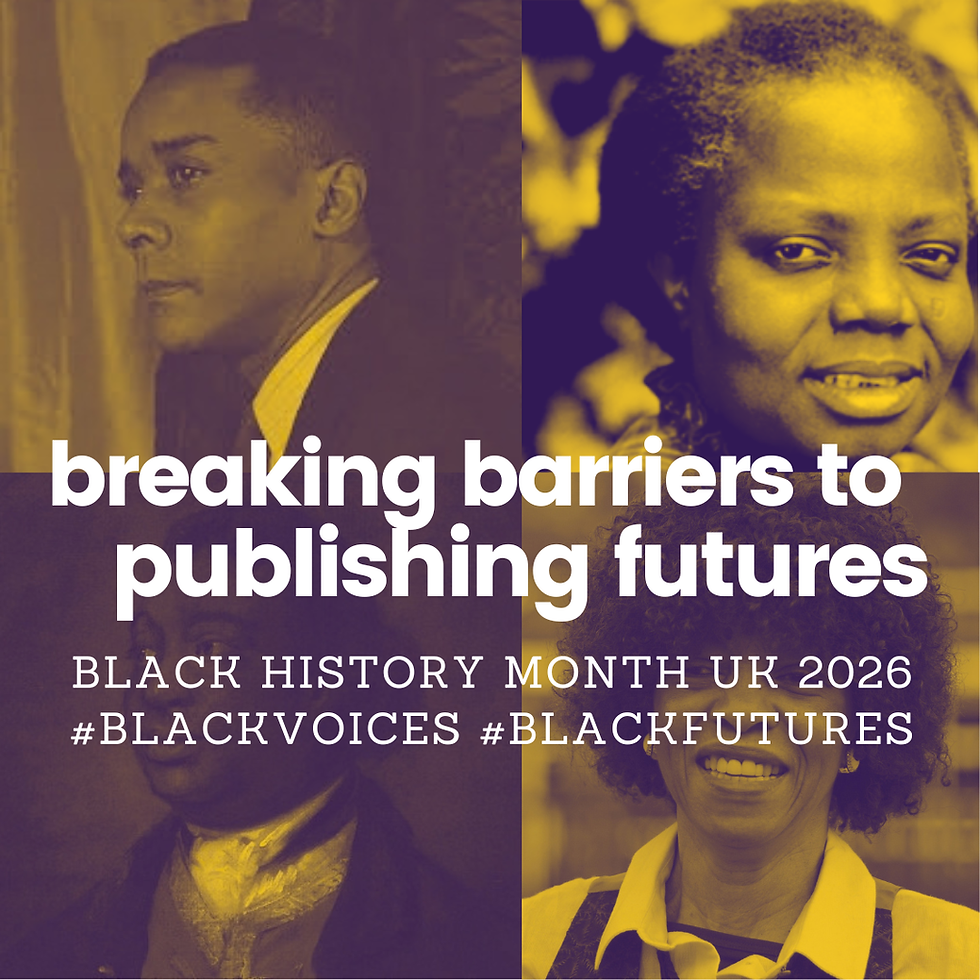
The theme ‘Breaking Barriers to Publishing Futures’ puts the power of storytelling at the heart of that history. From early Black writers and publishers to independent presses, literary festivals and today’s digital platforms, Black communities have continually created new ways to ensure their stories are told, shared and preserved.
Few examples embody this more powerfully than New Beacon Books, widely recognised as Britain’s first Black publishing house. Established in 1966 by John La Rose and Sarah White, it created a vital space for Black writing, ideas and activism. A year later, Margaret Busby became Britain’s youngest and first Black woman book publisher, challenging assumptions about who could hold influence within the industry.
But the barriers they confronted have not disappeared. In 2025, The Guardian reported that Black writers were finding UK publishing less accessible than before 2020, with Black people making up only around 3% of the publishing workforce. Sharmaine Lovegrove, co-founder of the Black Writers’ Guild, warned against treating increased attention to Black publishing as a passing trend: “The biggest mistake was seeing it as a trend as opposed to an opportunity to cultivate something meaningful that was missing.”
That is why Black History Month UK matters. It is not simply about looking back. It is about understanding who has been given the power to tell Britain’s story and who has been left out.
Do we really need Black History Month UK?
Some campaigners argue against the existence and usefulness of the month as they believe it marginalizes UK Black history and that it should, rightly, be remembered all year round.
Organisations such as The Black Curriculum are working hard to address the lack of Black British history in the UK curriculum through campaigning, training teachers, and delivering Black history programmes. While the Black Cultural Archives (BCA), an archive and heritage centre in Brixton, London, is dedicated to preserving and promoting the histories of African and Caribbean descendants in Britain.
But Black History Month UK, like many other national and international events, provides us with an opportunity to remember individuals and events that would never be included in a racially inclusive national curriculum and would remain forgotten to the annals of time.
What are the aims of Black History Month in the UK?
Celebrate and recognise the achievements of African and Caribbean heritage people's role in helping to shape UK culture, history, and economic development.
Educating the UK population on how the relationships between Britain, Africa, the Caribbean, and the United States helped create modern Britain.
To encourage government, institutions, and corporations to embrace and adopt equality and diversity policies.
What is the theme of Black History Month UK 2026?
Our theme for Black History Month UK 2025 is ‘Breaking Barriers to Publishing Futures’.
Form early Black writers and publishers to independent presses, literary festivals and today’s new generation of publishers and digital platforms, we’ll discover the people who turned barriers into opportunities, built communities and created new ways for Black stories to be shared, celebrated and heard.
We’ll shine a spotlight on the first Black publishing house New Beacon Books and celebrate notable Black Britons such as Margaret Busby, who is Britain’s youngest and first Black woman book publisher in 1967.
We also encourage the UK Black community to commemorate the month by sharing their own family histories using the hashtag #bhmfamilies
How can I celebrate Black History Month UK 2026?
Black History Month is an excellent opportunity for people from all backgrounds to educate themselves on Black Britain’s history and the often-overlooked people who have made a difference to the country. There are a variety of ways you can observe the month:
Attend any of the hundreds of events taking place up and down the country to commemorate Black History Month.
Show your support online by sharing our Black History Month UK post on your social media channel during the month.
Take on the #BHMFamilies selfie challenge
Why not check out out '31 ways to celebrate Black History Month UK' article for more ideas?
How should educational organisations and business corporations recognise the month?
The theme of Black History Month UK 2026 is ‘Breaking Barriers to Publishing Futures,’ and we advise any schools and colleges interested in exploring the topic in greater detail to visit The Black Curriculum website or attend Black Cultural Archive (BCA), which have an extensive range of educational resources relating to the theme.
We encourage business corporations to provide a safe space for all individuals who wish to commemorate the month in which stories can be shared – personal experiences and/or inspiring stories. But to also remember that not everybody may want to be involved in your Black History Month planning simply because of their ethnic background. Such assumptions place the burden of responsibility on them, and if they’re a visible minority in your workplace, they might feel tokenized about their role in your workplace. Remember, for best results, you should be recognizing all your employees, all year round!
Companies are also advised to run a diversity and inclusion audit of their business – and perhaps book a Black keynote speaker to provide advice on making their workplaces more racially inclusive.
Who is the International Black History Month UK (IBHM-UK) organisation?
The International Black History Month UK (IBHM-UK) was created in June 2020 by a group of Black Britons with a passion for investigating and curating the hidden and forgotten stories of Britain’s black past.
We’re committed to raising the profile of the month amongst the African, Caribbean and Black British community in the UK. As one of our young volunteer interns explains:
“Neither my primary or secondary schools celebrated Black History Month UK and I had to learn about UK Black History myself. So, I think it’s important that an organisation like this exists to fill the gaps in knowledge that many people in the UK’s African and Caribbean community may have about Britain’s black past. Our community is not a monolith, and we all have different lived experiences. BHMUK allows us all to reflect and celebrate on all the different aspects of British Black history from finding out about awe inspiring individuals like Dr Harold Moody and John Blanke to the legislative changes in UK law championed by the Windrush generation."
For too long, Black History Month UK has lacked direction and focus. We decided to step into that space to ensure that this important month has a clear message and theme. Our CEO, Angela says: “I have a young son who was tasked with choosing a notable Black Briton for a school assignment and I was shocked to learn that the only resources available was a listings website with poorly researched articles and filled to the brim with job adverts. We set up this organisation to ensure that quality information and free resources are available to everyone who wants to learn about UK Black History. And more importantly, that the stories of Black Britons are told in an authentic voice that belongs to us and not someone masquerading as one of us!“
We are a local community group that provides free resources on UK Black History and hope to run themed Black UK history events in 2027 and beyond.


Comments